Thursday, February 21, 2013

Kindred Spirits Art Workshop


Where do I go on Wednesday afternoons?
To Art Access/VSA where I'm teaching a six-week art workshop about planetary nebulae
This class is being taught through the "Kindred Spirits" program. It's a lot of fun!


I thought you might enjoy a tour of our classroom experience.


Here we are working on making a nebula collage. We tear tissue paper into small pieces and then glue it onto brightly colored card stock.


We dry our projects with a hairdryer then flip them over to work on the other side. 
When both sides are finished, we sprinkle our nebula with stars.


Our hands get a little sticky, but it is worth the effort.


  Here's our group effort:

And now for the star show.  Each of our nebulae are unique.
Just like the nebulae in deep space, no two are alike.


As we created our artwork, we were mindful to remember a few things about nebulae. 

  • Some nebula contain star nurseries. 
  • Some nebula clouds are the remnants of dead stars. 
  • Some nebula (like a super nova) explode in a violent fashion sending elements out into the universe.  These clouds of dust, depending on their composition (like hydrogen, helium, nitrogen and gold) have their own color. 
Although learning the science about nebulae was fascinating and helped us to understand a little more about our universe, creating our own nebulae with bright colors and shining glitter was the most fun! 

Wouldn't it be great to see our own nebulae creations floating up there among the stars?

Sunday, February 17, 2013

It's All About Layers

I was driving by Fairmont Park (two blocks from my studio) just as the sun was going down and I stopped to shoot an image with my iPhone. I returned to my studio the next day to begin painting a landscape of the scene.

Several layers later - I had "Last Glimpse of February," 16 " x 20" oil on canvas

Here's my process:


Saturday, February 16, 2013

Art Competitions - A Good Measuring Stick!


Even though the process of getting a painting juried into an art show is subjective, it is one way to demonstrate your success as an artist.

Getting your artwork into a show  can help you determine how viewers read your work. If your artwork is accepted then someone thought that it was good enough.


In the past, when my work did not get juried into a show, I usually cried as I drove myself home. The sting of rejection was horrible and I wore my heart upon my sleeve! Now, I don't take it personally. I realize that my artwork can still be of a high quality and not make it into a competition. Whether or not your painting gets in a show depends on many factors. Here are some of the criteria that a juror/judge might use:
  • Size. Many venues instruct their judge to jury in specific sizes of paintings. Example: maybe a huge amount of tiny paintings were submitted and the juror can only admit a few of them.
  • Medium. Some venues tell the juror to accept an equal amount of watercolor, oil and mixed media. If the "call for entries" has only two watercolor paintings submitted along with 300 oil paintings, you can bet that both of the watercolor paintings will get in.
  • Style. Let's say that the show is slated to be a contemporary show and your painting is very traditional. Chances of getting your painting into the show are slim. It helps to check out in advance what type of show is being held.


So, do you want to put your work to the test?  Are you tough? One sure way of becoming tough
(I like to call it confident) is to experience both rejection and acceptance.


Why not go for it and see what happens? There is something magical about seeing your framed work displayed under the lights!

Below is a list of local art shows that are held on a regular basis. If you know about them in advance, you can allow yourself a few months to paint something to enter. Now's your chance! Just call and ask the various organizations to send you a form or download the information online and follow the directions. These are the dates that the "call for entry" is due.  The show dates will be a week or two later.

January        Hogle Zoo Annual Art Show
                    
contact Jameson Weston 801-584-1739

January         Eccles Community Art Center  (Ogden)
                     
Annual Photography Competition
                      801-392-6935


Jan./Feb.      Bountiful/Davis Art Center (BDAC)
                    
Statewide Competition
                     801-292-0367


March           Springville Museum of Art (SMA)
                    
Annual Spring Salon

                      West Jordan Schorr Gallery "Spring Fling"
                      contact Linda 801-255-6698

                      Taylorsville City Arts Council  Art Show
                    

                      Ut
ah Watercolor Society
                     
Spring Show
                      www.utwatercolor.net

June              Wasatch Plein Air Painting (Midway, UT)
                     
Usually the last part of June through and including July 4th
                      http://www.midwayartassociation.org/

                      Provo Freedom Festival
                     
Fine Art Exhibit  801-818-1776

Jun
e              Eccles Community Art Center (Ogden)
                     
Statewide Competition

July
                Utah Watercolor Society
                     
Fall Show
                      utwatercolor.net

August           Utah State Fair
                     
www.utahstatefairpark.com
                      538-FAIR  (3247)

Nove
mber     Springville Museum of Art (SMA)
                     
Religious/Spiritual Show
                      www.smofa.org
                      801-489-2727

November     American Association of University Women  (AAUW)
                     
Annual Show
                      Due to privacy issues no phone number
                      www.aauwutah.org

Saturday, January 19, 2013

Create a Sketchbook You Can Be Proud Of

It all starts with the first page.

When someone opens your sketchbook, you want to catch their eye. For me, my title page is the hook. The thing that makes the viewer want to keep going...to look at the rest of my drawings.


The title page of my sketchbook is like the smell of fresh bread wafting from a bakery. It beckons the viewer to enter and sample the goods!
            
                                                Make your title page interesting. Better yet, make it amazing!


Each time you begin drawing in a new sketchbook, turn past the first page (leaving it blank) and begin your sketch on the second page. Later, when you have taken some time to think about how to make your title page special, go back and paint or draw on it.

Usually, my title page is the third or fourth page that I write on, however sometimes it's the last page I complete. It all depends on the inspiration that comes to me. Below is an example of a title page that I painted in small sections over a period of weeks. 

At first I didn't think about making my title pages look special. My artwork was pretty simple.


Then the idea of turning my title page into a visual appetizer came to me, so I jumped on it. 

Now it's a favorite part of my sketchbook. 


There are lots of ways to get creative. You don't have to limit yourself to drawing or painting. You can experiment with multimedia such as photography, stenciling or collage.


Make sure your full name or website name appears somewhere on the title page.  That way if you misplace your sketchbook or lose it altogether (Heaven forbid), the person who finds it can look up your contact information and return it to you.


Of course, filling your sketchbook with drawings and paintings is important too. A title page without a book - is no story at all!  So, get started! Fill up one book then begin another. What should you draw? Draw things that are near and dear to you. Draw your dog, your room, what you ate for lunch. Whatever you want!

The more you practice, the more you will improve!


Sunday, December 30, 2012

Tips About Sketching People

 
When is the last time you sat and drew a picture that had people in it?

I see.

You don't do people.

Well, don't be afraid. Jump in and draw. 

Keep a sketchbook in your purse or briefcase and whip it out when you are sitting in the doctor's office or when you are waiting to have the oil in your car changed. 

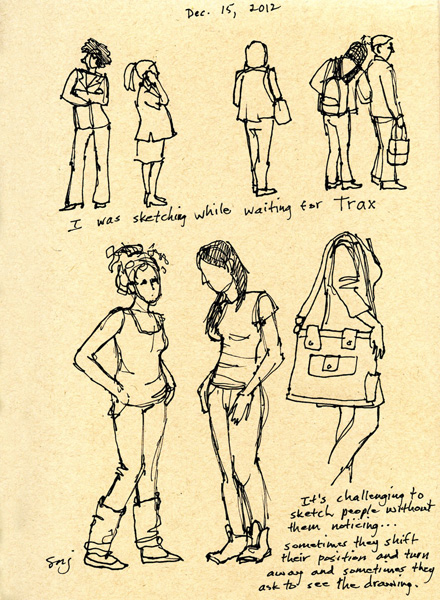
When I have a spare moment (it happens on occasion), I take out my sketchbook and start drawing.  Not only is it therapeutic, but it's challenging to capture the gesture of people - especially when you only have a few minutes to work.  


Sometimes, when I'm drawing a picture of a person, it's a matter of seconds before they move or shift their body position! When that happens, I simply start again.  I have a page in one of my sketchbooks that has a drawing of a two-year-old. It's really a compilation of six heads in various positions.  He moved around so much that I never had time to sketch the rest of his body.


When I draw, I like to use a sharpie marker. It's cleaner than using graphite (pencil) and because I can't erase my errors, drawing with permanent ink causes me to ignore my mistakes. It's a quick capture.  You are forced to draw continuously and the moment your pen hits the paper, you have a committed mark. No turning back.


Let's talk for a minute about mistakes.

If you look at the above drawings, you will see many mistakes - that's what I used to call them. Now, I don't even think about them...they're just there. For example, look at the boy seated with the laptop computer. You can see the computer through his leg.

Big deal.

Notice the guy seated in the round chair. His head is composed of two perpendicular ovals and a triangle nose. Who cares? Seriously. Sketching is all about the joy of drawing people. 
Take the challenge. 
Sit down somewhere and begin to draw.  Sketching is like everything else. You get better with practice. Here are some handy tips:
  • People are made of shapes. First, learn to see them - then draw them. Squares, rectangles, circles, etc.
  • See relationships between the shapes.  How far is the triangle from the square? How far is it from the hip to the knee and from the knee to the ankle? Is the length similar?
  • Leave out the face. Anonymity has a certain universal appeal.
  • Go for the big stuff like legs, arms and torso. Leave out the details.
  • Keep a piece of blank paper underneath the page on which you are drawing so that the ink doesn't bleed through.
  • Draw on ONE side of your notebook page (not on both sides)
  • Practice. Draw anything: objects, landscape or even people.

On occasion people will be aware that I am sketching them. They usually shift their body position and turn away from me. Sometimes they walk over to see my sketch. Once in awhile they say, "It doesn't even look like me." 

You get all kinds of reactions. Try to respond to them politely.

Most folks don't mind if you draw them, but some do. If I am going to render a detailed sketch (one that takes more time than a quick gesture), I usually ask the person for permission before I begin.  Otherwise, be discreet and try not to let them see you staring. If your drawing turns out nicely, you can email the person a copy of it (get their email address). 

Don't be afraid of how your drawing looks and avoid comparing your work to other artists. Each artist has their own style; their own interpretation of what they are seeing.

Here's Picasso...

And Matisse...


You will have your own style too.  It's like a signature - unique and original.

Buy a small sketchbook and a good pen.  Keep them nearby so that when you have some time in your schedule, you can practice drawing people, or for that matter - anything!
Drawing images of people is daunting at first, but it's a learned skill that can be rewarding.
Mostly, sketching is just plain fun!

Why not try it and see what happens?


Thursday, December 20, 2012

Workshop For Children!

Yes, indeed.  

I am going to teach a six-session workshop for children.

I'll be teaming up with the Clark Planetarium under the umbrella of Art Access, an organization in Salt Lake City that provides equal opportunities to inclusive arts programming for Utahns with disabilities and those with limited access to the arts. It's part of their program called "Kindred Spirits."

Kindred Spirits Workshop
Designed for children whose chronological and/or cognitive age is 5 to 13, the Kindred Spirits program offers young participants an opportunity to engage creatively in a variety of visual arts projects in an inclusive environment. By integrating children with and without disabilities, Kindred Spirits works to eliminate barriers, empower participants and foster growth.


A Workshop That Appeals to Astronomy Enthusiasts!
Painting Nebulae with Susan Jarvis
Wednesdays, February 5-March 12 from 4:30 to 6:30 pm.

Design and paint your own nebulae using a variety of mediums. Participants, under the instruction of the Clark Planetarium education staff, will explore nebulae – interstellar clouds of dust and gas. Students will create compositions of their own star-forming regions. Under the instruction of the teaching artist, participants will design their own nebulae and paint them. 


To register online, click here.

Artwork created in these Kindred Spirits workshops will be exhibited at The Clark Planetarium in honor of the Planetarium's 10th Anniversary at their location in The Gateway. The exhibit will open on April 4, 2013 and will also contain juried artwork from other youth in the community.


Class Schedule:
Every Wednesday from 4:30 to 6:00 PM (see dates above)

Max Enrollment:
7 students  (14 when including their partners, a parent or a sibling).

Fee:
$50 - includes all art supplies and snacks (no fee for partner companion).

Location:
Art Access Gallery, 230 South 500 West, #125 in Salt Lake City

Contact:
Amanda Finlayson 801-328-0703, option #5


Saturday, December 1, 2012

Come With Us To Italy!


Have you ever wanted to combine your travels in Italy with an adventure in painting and sketching? Well, now is your chance to join us for a two-week art study abroad!

Yep.  we're going!

Join us for a memorable exploration of the Italian countryside through illustrated journaling and watercolor sketching featuring you as the artist.

Let us teach you!


Enjoy an introduction to watercolor techniques and new painting surfaces by team teachers Steven K. Sheffield and Susan N. Jarvis. Make new friends as you paint side-by-side with your fellow artists. Discover your hidden talents and bring home artwork that was painted by you in sunny Italy.

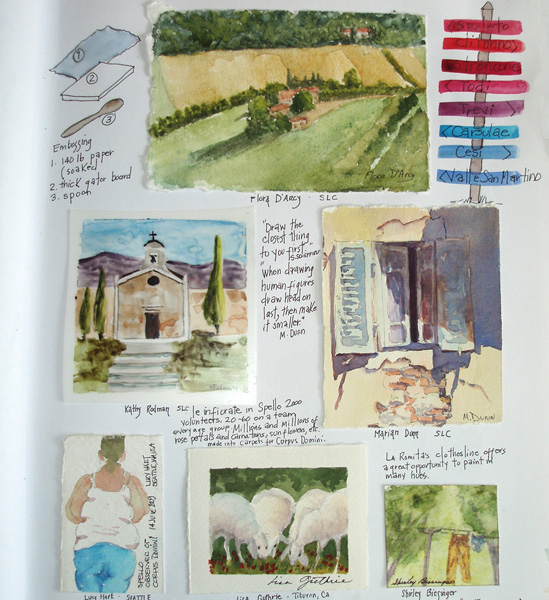
Here are samples of the type of work that you will be learning: 


If you want to learn more about this trip, you can click on the "Italy" tab of my website or check out the La Romita website at http://laromita.org